- Supercool
- Posts
- 🌐 The $2.2 Trillion Year: Clean Power Keeps Compounding
🌐 The $2.2 Trillion Year: Clean Power Keeps Compounding

Josh Dorfman
December 30, 2025

I’ve been reading The Code: Silicon Valley and the Remaking of Modern America by Margaret O’Mara during the holidays. I wanted to understand the Valley’s history and whether its growing ties to the U.S. military are a new phenomenon. It turns out, it’s as old as Silicon Valley itself.
For decades, Lockheed Martin, the military defense contractor, was Silicon Valley’s largest employer, peaking in 1987 with around 25,000 employees—more employees than Apple and Intel combined.
Electronics. Semiconductors. Stanford University’s rise as a prestigious research university. All tied directly to military spending. There would be no Steve Jobs. No Instagram. No DoorDash or Airbnb headquartered in the Bay Area were it not for America’s Cold War needs for advanced missile systems.
I don’t write this as an indictment. What fascinates me and jumps out in the book is how the VCs, founders, and marketers in the Valley intentionally seeded a different narrative with lawmakers on Capitol Hill and in the national media as the 1980s got underway. It’s precisely what we associate with Silicon Valley today: high tech, risk-taking, wealth creation, and free enterprise.
That narrative took hold because it contained growing truths and because America needed it.
The 1970s had stagflation, oil shocks, geopolitical anxiety, a flailing auto industry, and institutional distrust. America felt like it was declining.
Americans were looking for proof that tomorrow could once again be better than today.
Silicon Valley, through the rise of Apple and others, gave it to them.
Which leads to the recent conversation I had with Akshat Rathi, in many respects a kindred spirit in his professional commitment to capturing, chronicling, and accelerating a clean, abundant, zero-carbon future.
Akshat is a senior climate reporter for Bloomberg. He is the author of Climate Capitalism: Winning the Race to Zero Emissions and host of the podcast Zero: The Climate Race.
As 2025 wraps up, and we prepare for the year ahead, I wanted to understand how he sees this moment. Because to me it looks like this:
America is beset once again with malaise. We are directionless, distrustful, anxious about decline, and concerned that our best days are behind us.
Americans are concerned about Climate Change, but far more concerned about immediate, pressing, and increasingly acute issues like affordability, job security, and healthcare.
And yet, trillions are now flowing into climate solutions that are proven, scalable, and already underway. Solutions that also make life more affordable, grow jobs, and improve our health.
Solving climate change is the path to a prosperous, abundant future. Not sacrifice, guilt, or austerity, but cheaper energy, better mobility, cleaner air, more resilience, and a higher quality of life.
Solving climate change is, therefore, a path to a new American story. A story of reinvention, purpose, and the idea that tomorrow can once again be better than today.
And I thought, perhaps, even though 2025 was turbulent, Akshat sees it too.
Akshat sits in London. He was raised in India. His lens on climate is global.
I asked him for his one-sentence headline to recap 2025. His reply:
“The world's largest historical emitter, the second largest current emitter, has a president who thinks climate change is a hoax—and says so at the United Nations.”
President Trump’s words have turned into tangible impacts both in the U.S. and abroad. Since taking office earlier this year, Trump has:
Rolled back the Inflation Reduction Act’s support for solar, wind, and EVs
Pressured the International Energy Agency to stop publishing net-zero forecasts
Bullied countries to kill a long-negotiated global shipping carbon tax
Pushed the EU to dilute its stance on corporate ESG reporting
Compelled once-upon-a-time climate champions like Canada's Mark Carney to roll back EV mandates and carbon pricing
In many respects, this is the worst political moment for climate action in a generation.
And yet.
The Irrefutable Investment Flows
Global clean energy investment in 2025: $2.2 trillion.
That’s up from $2 trillion in 2024. And roughly double what's flowing into oil, gas, and coal combined. It's unprecedented. Unstoppable.
"The energy transition has a kind of momentum which will sustain it," Akshat said, "even with clear, huge, big attempts from the largest economy to try and slow it down."
While the U.S. president calls climate change a hoax and renewable energy a scam, the global economy is wiring itself for a clean, electrified future.
Not to cut carbon emissions or save the planet. There are more immediate national interests at play: it's about powering fast, cheap economic growth.
To See That Future, Look To Developing Countries
As Akshat sees it, clean energy and electrification have moved beyond the domain of the developed nations. It's now a developing-country growth story.
Two examples he pointed to:
Pakistan
Pakistan imported and installed as much solar power in the past year as half of its existing energy grid.
Ethiopia
In 18 months, Ethiopia went from 0% market share for electric vehicles to 8.3%.
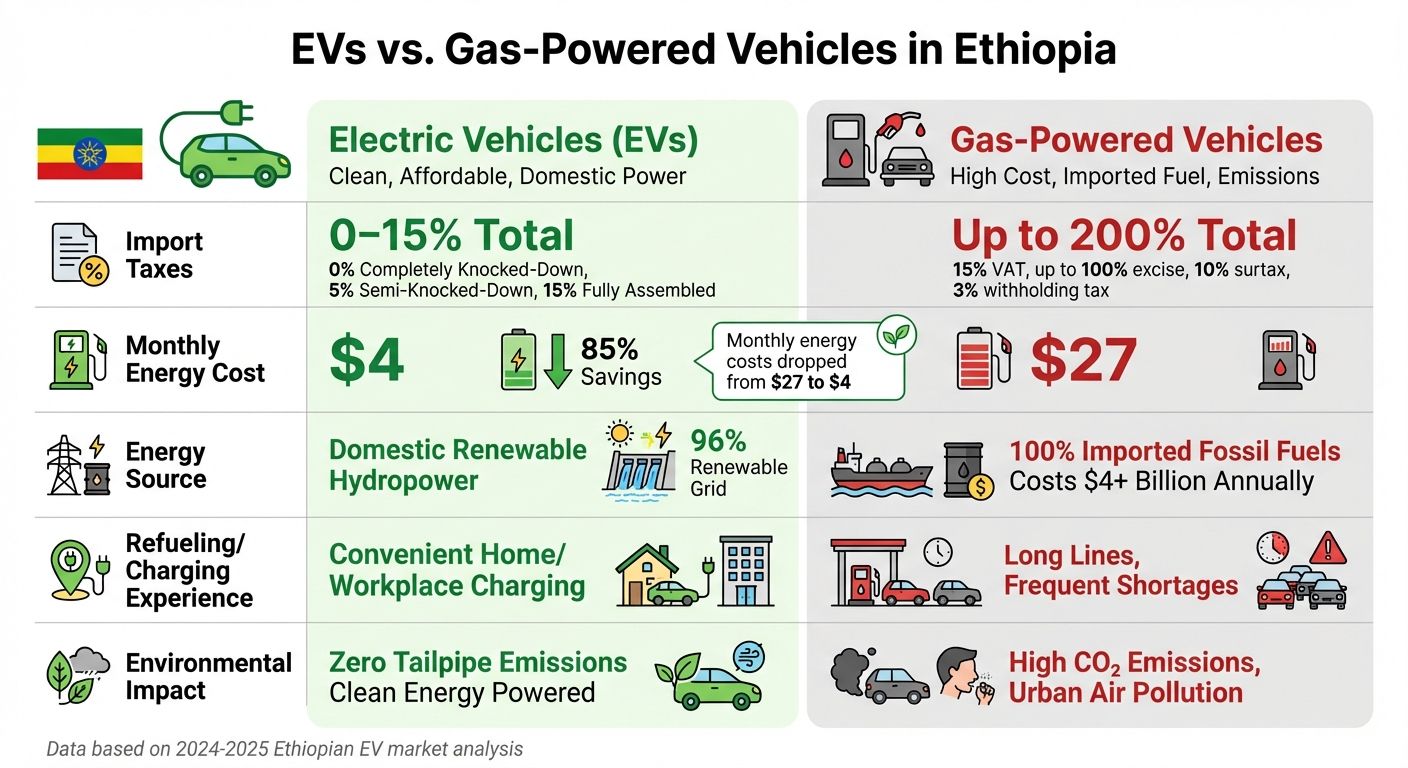
The case for EVs in Ethiopia.
The two primary drivers behind the acceleration:
1. Cost
"Developing countries are embracing clean energy for cheap energy’s sake, not for carbon emissions’ sake," Akshat said.
2. Growth
Electrification is the only form of energy with a tight correlation to economic growth. The richer you are, the more electricity you consume.
For decades, that trend held steady in the developed world. Then it broke.
In the 2010s, rich countries deindustrialized. Factories moved overseas. Economies shifted to services and software. GDP continued to grow, but electricity demand flattened. Europe and the U.S. stopped building major power infrastructure.

U.S. electricity consumption was flat from 2010 to 2020. It’s now rising. Source: EIA
Now demand is surging back. AI data centers. EV charging. Heat pumps. Reindustrialization. The U.S. and Europe are suddenly facing 2-4% annual growth in electricity demand.
But we’ve forgotten how to build it.
Developing countries, on the other hand, have been running at 5-10% annual growth for years—building grid capacity, connecting remote regions, and racing to keep pace with economic expansion.
"Rich countries are struggling to get enough electricity supplies for their growth," Akshat said. "And as a result, [they] are not growing as fast and are essentially leaving economic growth behind," said Akshat.
In an unexpected turn, it’s the U.S. and Europe that now need knowledge transfer between nations to start running in reverse.
"Developed countries should be looking to developing countries for how to build their electricity infrastructure," Akshat said.
America Invents. China Installs.
So who's behind all this fast-paced deployment?
In a word: China.
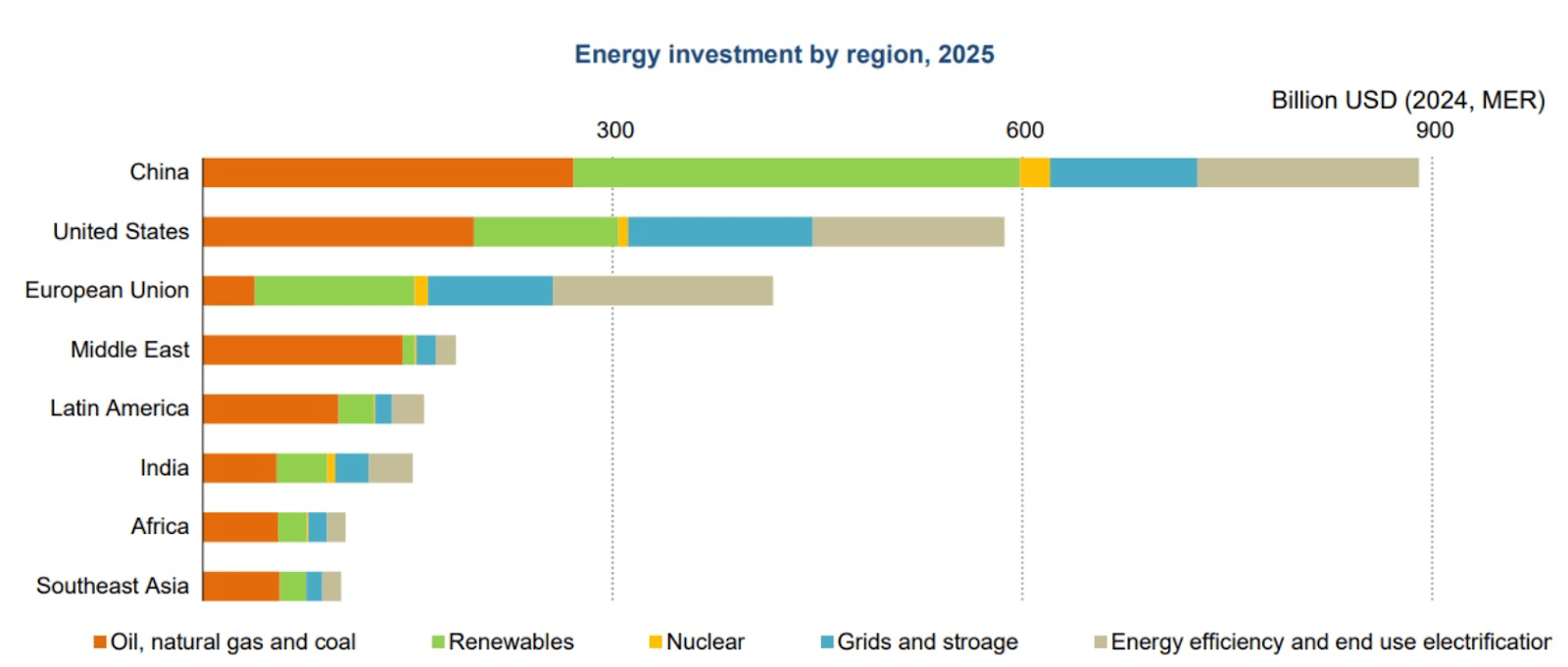
China dwarfs the rest of the world in clean energy investment. Source: IEA
Akshat's thesis as he looks to 2026 and beyond: China is doing to electricity in the 21st century what Standard Oil did to petroleum in the 20th century.
Standard Oil didn't just sell oil. It exported entire energy systems—infrastructure, expertise, capital, and know-how for oil extraction, refinement, distribution, and delivery.
China is now doing the same. It’s not just exporting solar panels and grid-scale batteries. It’s exporting everything that enables electrification itself:
Low-cost equipment
Contractors who can build it
Grid know-how to connect it
Financing to fund it
Operations to keep it running
Countries get a path to a clean, energy-abundant future. And the value grows over time. Partnering with China has enabled countries such as Ethiopia and Brazil to begin building their own electrification industries.
As Askhat recounted what’s happening around the world, one thought kept occurring to me.
In America, we are still optimizing for invention. We act like the goal is to invent the technologies that will enable the low-carbon future. Meanwhile, China is already installing it.
There's more at stake than just solving climate change. This is about global power, influence, and leadership.
The New Climate Story
As we wrapped up our conversation, we touched upon the climate movement’s greatest challenge.
"In the last 10 years under the Paris Agreement, we have grown in numbers," Akshat said. "The number of people involved in tackling this problem, thinking about it day to day, has grown tenfold, hundredfold."
That would appear to be good news, save for—"That growth has also forced us to specialize," said Akshat. "There are now carbon removal industries that focus on biochar—one specific thing—and there are 20 companies and hundreds of people working on it. That's good. But I think in that process there's been two big problems."
One: "We've forgotten the big picture."
Two: "We are not communicating to the rest of the billions of people who don't think about climate every day, but whose lives we hope will be made better because of acting on climate change."
The retrenchment on climate action is not just about Trump.
"Fundamentally, I think the story that needs to be changed is that we need to prove to people why this is in their best interest now and in the future," said Akshat.
I agree.
🌐 Supercool Takeaway
The $2.2 trillion in energy transition capital is real and accelerating. The driver is modernization—demand for fast, cheap, and reliable power.
Foolish, ill-informed politicians can slow the transition, but the momentum can’t be stopped.
Pakistan isn't going solar to save the planet. Ethiopia isn't electrifying its fleet for carbon credits. They're doing it because it's the fastest path to a prosperous, modern economy and a clean, abundant future.
That's the story. Tell it well, and tomorrow can be better than today.
This Week’s Podcast Episode
The $2.2 Trillion Year: Clean Power Keeps Compounding
🎙️ Listen on Apple, Spotify, YouTube, and all other platforms.
↓
Stat of the Week: 3,059
China dominates electric buses, yet Santiago, Chile, has the third-highest number of electric municipal buses in the world (3,059). It’s another striking example of how the developing world is racing toward a clean, electrified future.

Source: Electrive
Quote of the Week:
In the process of avoiding climate change, you build a far better future. And that better future is actually now. It’s within the grasp of people.
↓
🌐 The Climate Adoption Playbook

Climate innovation is half the battle. The other half? Getting customers to adopt it.
The good news is that successful climate companies have figured it out. The great news is they all do the same thing.
They pull from a set of five adoption levers. Sometimes they use just one. Often, they combine them to create even stronger value propositions. But, no matter the market or industry, their entire playbook consists of these levers:
🧩 Friction Removal (Make it easier)
✅ De-Risked Adoption (Make it credible)
🎨 Lifestyle Upgrade (Make it aspirational)
💳 Financing as the Unlock (Make it affordable)
♻️ Circular Advantage (Make it profitable)
The Climate Adoption Playbook teaches you how to use these levers too. It’s the first course built on real-world case studies of companies that have gone from pilots to commercial scale to meaningful market share, now shaping the low-carbon future.
To make it easier to dive in during the holidays—and as you gear up for the year ahead—we’re offering a special holiday price.
Now through January 15, 2026, the course is discounted from $499 to $199, with ongoing access and updates for the next year included.
↓
Coming in 2026: Deployed — Supercool’s newest newsletter.
Deployed tracks what grew the low-carbon economy this week: powered on, ribbon cut, in service.
No groundbreakings. No funding rounds. No pledges.
If it isn’t operating yet, it isn’t Deployed.
Here are a few quick snapshots of what’s coming every Tuesday starting in January.
What Grew the Low-Carbon Economy This Week:
Fast EV charging is now live at Pennsylvania Turnpike service plazas along one of the state’s busiest corridors—bringing reliable, on-route charging to the stops drivers already make. The first site was built with federal support through the National Electric Vehicle Infrastructure (NEVI) program, which funds fast, dependable charging on major routes. The result: EV road trips get more predictable because the infrastructure is where people already travel.
Mecca—destination for one of the largest annual travel surges on Earth—is electrifying how millions of pilgrims move during Hajj. The city has launched its first fully electric bus rapid transit line, the Masar BRT, running in dedicated lanes along a key corridor linking major transport hubs to areas near the Grand Mosque. This is deployment at scale: cleaner transport, higher throughput, and a system designed for peak-season reliability.
A reclaimed, decommissioned coal mine site is now home to a 160MW solar plant in Garrett County, Maryland. The project—Backbone Solar—has entered commercial operation, operated by CPV Renewable Power in partnership with Harrison Street Asset Management (HSAM), and built by Vanguard Energy Partners. It’s a clean-energy repowering story: legacy land, new generation, now producing.

Irvine, California—at the center of Orange County’s fast-growing healthcare corridor—is now home to a fossil-fuel-free hospital: UCI Health – Irvine, a seven-story, 144-bed acute care facility that runs entirely on electric power. Heat pumps, rooftop solar, and design choices like floor-to-ceiling windows reduce energy demand while keeping patient care front and center. Even the commercial kitchen is electric—because patients still want French fries, they just don’t need natural gas to fry them.
And One Un-Deployed Story As We Say Goodbye to 2025: Jaguar Produced Its Last Gas-Powered Car
Jaguar has built its final internal-combustion vehicle: a V8 F-Pace SVR that rolled off the line on December 19, 2025, in Solihull, England—ending roughly 90 years of gasoline-powered Jaguar production as the brand shifts to an all-electric lineup. The last ICE Jaguar is being preserved by the Jaguar Daimler Heritage Trust for display at the British Motor Museum in Gaydon. RIP.
↓
Interested in Advertising with Supercool?
Connect with future-forward decision-makers seeking next-gen climate innovations. Reach out to discuss how Supercool’s platform can help. Just hit reply to this email.
↓
Not yet subscribed to Supercool?
Click the button below for weekly updates on real-world climate solutions that cut carbon, boost the bottom line, and improve modern life.
🌐