- Supercool
- Posts
- 🌐 The Clean Energy Transition Runs on Affordability
🌐 The Clean Energy Transition Runs on Affordability

Josh Dorfman
January 01, 2026
The last time I spoke with Jigar Shah on a podcast was in 2018. Back then, my show was called The Last Environmentalist. Not exactly "Supercool" in tone, I know.
But I was moved by a line from President Obama: we're the first generation with the knowledge to understand the issue of climate change—and the last with a chance to do something about it.
Jigar Shah has been doing something about it his entire career.
In climate circles, Jigar needs no introduction (see Wikipedia bio).
He pioneered solar financing at SunEdison.
Launched the Carbon War Room with Richard Branson.
Co-founded Generate Capital and built it into a billion-dollar fund backing commercial-ready clean technologies.
Directed the U.S. DOE Loan Programs Office during the Biden Administration, which deployed over $100 billion in debt financing for clean energy and advanced transportation projects.
Today, he runs the clean tech advisory and catalyst firm Multiplier.
When Branson tapped Jigar in 2009 to run the Carbon War Room, Jigar treated it like a Churchillian war room. The idea wasn't just to build clean energy companies—it was to prepare solutions so they'd be ready when a crisis struck.
In our 2018 conversation, Jigar laid out his theory: When Miami eventually falls into the ocean, and the emergency becomes undeniable, we will need technologies that are de-risked and deployable at scale, so the government can mobilize them as it mobilized production during World War II.
Seven years later, we reconnected. I asked for his one-sentence headline to summarize 2025.
"100% of all electricity load growth in the entire world—for the first time in my lifetime—came from solar, wind, and nuclear."
He paused for emphasis.
"The whole world. China, India, Ethiopia, Mexico, and the United States. And that will be the case for the rest of my lifetime."
This happened during a year when, as Jigar put it, "the sitting president of the United States is basically just badmouthing your industry all day."
The moment Jigar spent decades preparing for has arrived. Just not the way anyone expected.
People Are Solving It Themselves
The federal government isn't offering affordable energy solutions. U.S. Energy Secretary Chris Wright talks about geothermal and fusion. Great technologies, but utility-scale geothermal is not yet operational, and fusion is still years, perhaps light-years, away.
"When people are truly in trouble, they reach for solutions," Jigar said. "And the federal government is not offering any."
So people are finding their own.
Today, you can buy a battery online and plug it into your outside outlet. No electrician needed. "There are Father's Day specials that are saying, here, buy this $3,000 battery and you could run your television in the backyard with all the boys," says Jigar.
The shift isn't about climate anymore. It's about affordability.
The President often points to gasoline prices as a cure-all for energy. But as Jigar points out:
"Natural gas prices have almost doubled in our country. I don't heat my house with gasoline. I don't power my flat screen TV and keep my beer cold with gasoline. The fact that my electricity rates are up because natural gas prices are up means I have to go get another solution."
And when people look for that solution, they discover clean technologies that save them 20% on their electricity bill while making them more self-reliant.
Every Crisis Now Features Clean Energy
Jigar's original theory was that we'd need a Miami-underwater moment to mobilize. Turns out other crises work too.
In Pakistan, when the Chinese-built natural gas plant failed, and the country plunged into rolling blackouts, citizens didn't wait for the government. "25% of the whole country's grid is now on solar. One household at a time, one YouTube video at a time, because it was all DIY," Jigar said.
When Russia invaded Ukraine, Europe deployed a "gargantuan amount of heat pumps" and energy efficiency measures.
When Ethiopia's new hydropower facility created excess capacity, the government banned internal-combustion-engine cars.
When Indonesia's energy subsidies hit 10-12% of their federal budget, they said, "We need to replicate what Pakistan did."
"In every single place around the world where people are facing a crisis, people are saying, 'Hey, what about this thing that's been going on for 20 years in the background that I haven't been paying attention to? Could there be a solution in there?" Jigar said.
Even in Red states:
"Governors are running for re-election in '26 who are like, 'I'm going to lose my job unless I have a real policy around this. I tried to use building more natural gas as my official policy. That's just raising rates even faster. I know I'm supposed to be anti-solar and wind, but I might get voted out of office if I don't deploy this stuff.'"
The Impediments Are Self-Made
If the solutions are here and economically superior, why isn't deployment faster?
Jigar's answer is blunt: utility CEOs.
"You do zero work. You say no to everything. You raise everyone's rates by double the price of inflation every year, and you never get fired. You're making $26.1 million a year to do jack squat."
But even the good utility CEOs are trapped in the system. Jigar pointed to Gil Quiniones at ComEd:
"He's like, look, Jigar, I cannot do all this decision-making on my own because I would get fired. So I need the state of Illinois to pass a law that forces me to do this stuff. Then I can go to my shareholders and say, look, I'm doing this because Illinois is forcing me to do it."
Illinois passed that law. Now, ComEd is deploying a billion dollars' worth of batteries that will save ratepayers $12 billion.
The other impediment? Elected leaders who don't realize what they can do to effect change and cut costs.
"It's all norms," Jigar said. "Utility companies are fully regulated monopolies that serve at the pleasure of elected officials. Mayors and governors have enormous power over infrastructure spending—but most haven't exercised it since the 1960s, so they don't realize they still have it."
An example of a Mayor who figured it out:
"The mayor of Cincinnati built a 100-megawatt solar farm and locked in lower prices in 2018. Now, Cincinnati has half the generation costs of the rest of Ohio. Every mayor in deregulated states could do this next week. Almost none have," Jigar said.
The Real 2026 Bottleneck
I asked Jigar what he sees ahead.
"I see a huge worker shortage," he said immediately. "We have 20% unemployment right now for young people. We need to get them all into the trades. Electricians right now building data centers are making $500,000 a year. These are great careers. You look swole after coming back from a day's work."
The technologies are ready—the economics work. The capital is flowing.
The constraint in 2026 won't be invention or deployment capital. It'll be whether we have enough electricians to install it all.
🌐 Supercool Takeaway
For two decades, Jigar Shah prepared for the moment when crisis would make clean energy deployment inevitable. That moment arrived in 2025—not through a single catastrophe, but through multiple crises.
Pakistan went solar because natural gas failed. Europe deployed heat pumps because Russia invaded Ukraine. American households are installing batteries because natural gas prices doubled.
Clean energy isn't winning on virtue. It's just winning. The solutions are here, proven, and economically superior.
This Week’s Podcast Episode
The Clean Energy Transition Runs on Affordability
🎙️ Listen on Apple, Spotify, YouTube, and all other platforms.
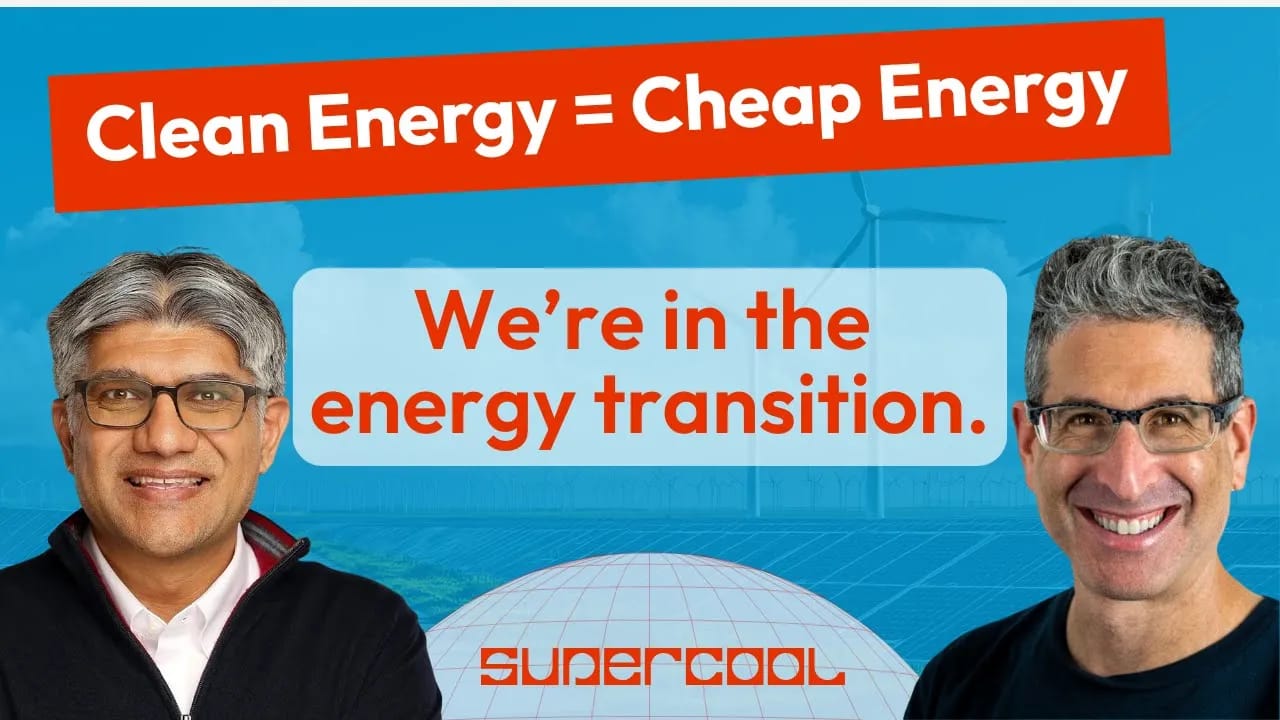
↓
Stat of the Week: 100%
In 2025, for the first time in history, every new kilowatt-hour of energy load growth came from clean energy sources.
From Jigar:
"The thing that people don't understand is we're building new natural gas, but we're retiring natural gas at the exact same rate that we're building new natural gas. We're retiring coal at the exact same rate that they're building new coal. 100% of all growth is coming from clean sources.”
Quote of the Week:
Every single crisis, which seems to be happening with more and more regularity, is now featuring clean energy technologies as a solution.
↓
🌐 The Climate Adoption Playbook

Climate innovation is half the battle. The other half? Getting customers to adopt it.
The good news is that successful climate companies have figured it out. The great news is they all do the same thing.
They pull from a set of five adoption levers. Sometimes they use just one. Often, they combine them to create even stronger value propositions. But, no matter the market or industry, their entire playbook consists of these levers:
🧩 Friction Removal (Make it easier)
✅ De-Risked Adoption (Make it credible)
🎨 Lifestyle Upgrade (Make it aspirational)
💳 Financing as the Unlock (Make it affordable)
♻️ Circular Advantage (Make it profitable)
The Climate Adoption Playbook teaches you how to use these levers too. It’s the first course built on real-world case studies of companies that have gone from pilots to commercial scale to meaningful market share, now shaping the low-carbon future.
To make it easier to dive in during the holidays—and as you gear up for the year ahead—we’re offering a special holiday price.
Now through January 15, 2026, the course is discounted from $499 to $199, with ongoing access and updates for the next year included.
↓
Reflecting on 2025, we’ve been fortunate to gain insights from remarkable builders and thought leaders. Some highlights that jump out:
Eric Corey Freed — The Architect Who Doesn’t Wait For Permission

Eric wrote Green Building For Dummies two decades ago. He’s a legend in green architecture. In 2020, he was recruited to Cannon Design to transform the design firm into a global sustainability powerhouse. His efforts were recognized by Metropolis Magazine, which awarded the company Planet Positive Firm of the Year in 2024.
“The biggest mindset shift, and this is one, is really driving everything that we do, is that I’m not here to sell you on sustainability. I’m here to sell you on the outcomes and benefits that sustainability provides.” — Eric
Podcast | Newsletter | YouTube
Candice Xie — The Founder Who Builds Ridesharing Profitably

Candice defies strereoptyes of the venture capital “backable” founder. A young immigrant woman who was then based in Indiana, Candice launched Veo’s ride-sharing service on her alma mater’s campus—Purdue University—in 2017.
Today, Veo operates in 50 markets nationwide with its bikes and stand-on and sit-down e-scooters. Candice credits the company’s circular design philosophy for keeping costs low and fleets in circulation for longer, enabling the company to accomplish something unique among VC-backed startups: scale profitability.
“We weren’t in the Silicon Valley bubble. That forced us to focus on fundamentals, on how to build a business that lasts. We weren’t chasing the next valuation target; we were building for the next fifty years.” — Candice
Podcast | Newsletter | YouTube
Chris Atkins & Chris Roe: The Executives Who Scale Low-Carbon Impact Globally

No company operates at a greater scale than Amazon. And few are more committed to reaching net-zero—and bringing the rest of the corporate world along with them—than the largest retailer on Earth.
Chris and Chris are at the forefront of Amazon's operationalization of The Climate Pledge to reach net-zero by 2040. That leads to striking counterintuitive, data-backed insights such as: faster delivery equals lower emissions. It’s also what drives Amazon to be the largest corporate purchaser of renewable energy for five years in a row.
“We go where the clean power has the most impact. If you’re adding renewables to the grid that’s already 90% clean, it doesn’t change much. Add it to a coal-heavy grid in South Africa, and you shift the carbon math overnight.” — Chris Roe
Podcast | Newsletter | YouTube
↓

The Land Development Podcast: Sustainable Growth in Housing with Josh Dorfman
↓
Interested in Advertising with Supercool?
Connect with future-forward decision-makers seeking next-gen climate innovations. Reach out to discuss how Supercool’s platform can help. Just hit reply to this email.
↓
Not yet subscribed to Supercool?
Click the button below for weekly updates on real-world climate solutions that cut carbon, boost the bottom line, and improve modern life.
🌐